
The phrase “Google Ads versus Facebook ads” hides an important distinction. Google Ads includes several campaign types; this comparison focuses on search ads against advertising in social feeds. A search campaign and a visual discovery campaign may play different roles in the same customer journey.
Identify the buying situation
Someone searching for an urgent repair has already described a problem. A relevant search ad can connect that demand to a provider. The challenge is matching the query, location and landing page while excluding unsuitable traffic.
Someone browsing a social feed may not be actively shopping. A useful demonstration can introduce a product, show how it works and give the person a reason to investigate. That first interaction may lead to a later visit rather than an immediate purchase.
These are planning tendencies, not fixed rules. Social ads can produce immediate sales, and search users can be researching rather than buying. The actual campaign data must determine whether the audience is valuable.
| Decision factor | Search ads may fit when | Social ads may fit when |
|---|---|---|
| Demand | Customers search for a named solution | Customers need to discover the offer |
| Explanation | A short promise matches an existing need | A demonstration makes the benefit clear |
| Assets | A relevant landing page is ready | Strong images or videos are available |
| Response | Calls or enquiries can be handled | Messages and comments can be handled |
| Evaluation | Qualified search leads can be traced | Creative and downstream outcomes can be traced |
Compare the whole journey
A lower cost per click does not establish a better channel. Cheap visitors may have little intention to buy. Equally, an expensive click can be worthwhile if it leads to a valuable customer at a sustainable rate.
Use a shared definition of a qualified lead. Suppose two hypothetical campaigns each spend PKR 20,000. Search produces ten enquiries, of which six qualify. Social produces twenty enquiries, of which four qualify. Search costs about PKR 3,333 per qualified lead, while social costs PKR 5,000. The apparent winner changes when quality enters the calculation.
This is an arithmetic example, not a prediction that search always performs better. If the social enquiries close more often, generate larger orders or influence later purchases, the business conclusion could change again. Include those outcomes where they can be measured credibly.
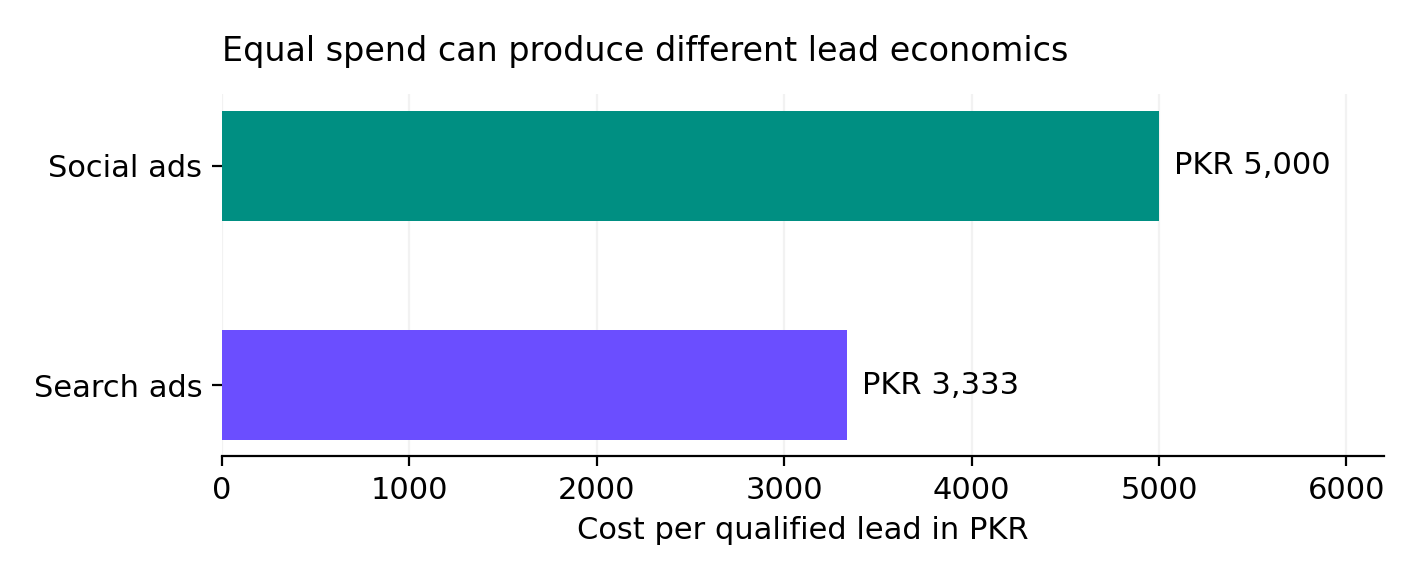
Illustrative calculation only. Figures are hypothetical and are not campaign benchmarks or client results.
Match the channel to the operating team
A campaign that generates messages requires someone to respond, ask useful questions and record the outcome. An unanswered inbox can waste a promising offer. Write a response process before increasing message volume, including who covers weekends and when a lead moves to sales.
A search campaign needs the same operational discipline. Calls must reach the correct person. Forms must arrive in a monitored inbox or CRM. The landing page should explain eligibility, location and next steps so customers can decide whether the service fits.
Do not advertise products that are unavailable or promise appointment times the business cannot honour. Availability is part of campaign quality because it determines whether interest can become a completed transaction.
Run a comparison that can teach you something
Begin with a single offer and a defined audience. Set a reporting period that includes the normal sales delay. Record media spend, creative costs, enquiries, qualified leads and completed sales using consistent definitions.
If the budget is small, sequential tests may be more practical than splitting it across many campaigns. However, acknowledge that seasonality or a promotion can make sequential periods different. If running simultaneous tests, keep the commercial offer comparable while adapting creative to each platform.
Google’s conversion measurement documentation explains how ads can be connected to valuable customer actions. Choose meaningful actions and validate the setup before interpreting a platform’s conversion total. [1] A click on a contact button should not automatically be treated as a completed sale.
Know when combining channels makes sense
A combined approach becomes more useful when each channel has a defined job. Social content can demonstrate the offer and answer objections. Search ads can capture relevant demand when people investigate a solution. The business still needs to avoid counting the same customer twice in its combined report.
For a small business, operational simplicity often matters more than having a presence everywhere. A single well-managed campaign with clear feedback can be more useful than several campaigns that nobody has time to evaluate.
Frequently asked questions
Are social media ads always cheaper than Google Ads
No. Costs vary with the audience, auction, creative and objective. Compare qualified customer outcomes rather than assuming a platform has a permanent price advantage.
Which channel should a clothing business test first
A visual product may suit social discovery, while product-specific searches may suit search advertising. Product economics, creative quality and available demand should guide the first test.
Can I use one landing page for both channels
Yes, if it answers both audiences’ questions. If their intent differs substantially, adapt the explanation while keeping the offer accurate.
Review PPC management options and social media marketing support to choose a channel plan that matches your resources.

About Huzaifa Mansoor
Huzaifa Mansoor is a Karachi-based SEO consultant and founder of HuzDigital, helping businesses improve technical SEO, content performance, Local SEO and AI-search visibility.