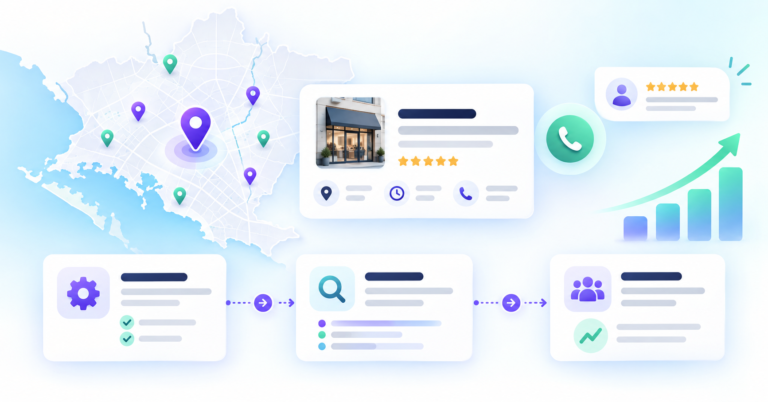
Quick Answer (AEO Summary): Ranking in the Google Local 3-Pack without stuffing keywords into your Google Business Profile (GBP) name relies on four compliant signals: selecting the exact high-intent Primary Category, linking the GBP to a geo-optimized service landing page with
LocalBusinessschema, generating steady customer reviews that naturally mention specific services and neighborhoods, and maintaining strict Name-Address-Phone (NAP) consistency across local directories.
Why Keyword-Stuffed Business Titles Are a Ticking Time Bomb
Stuffing city names and service keywords into a Google Business Profile title violates Google\’s guidelines unless those words are part of your registered legal entity and physical storefront signage. A single competitor \”Suggest an Edit\” submission or automated sweep can trigger a hard suspension, wiping your listing off Google Maps during peak lead season.
Sustainable local market dominance comes from engineering the ranking signals that Google weighs alongside your business title. You can explore our full compliant methodology on our dedicated Local SEO Services page.
Google Local 3-Pack Ranking Signal Weighting
| Local Ranking Signal | Algorithmic Weight | White-Hat Execution Standard |
|---|---|---|
| GBP Primary & Secondary Categories | Very High (35%+) | Match primary category to your core revenue service; add 3–5 exact secondary categories |
| Linked Landing Page Authority | High (25%) | Link GBP to a fast, localized page with embedded map, LocalBusiness schema & city H2s |
| Review Velocity & Keyword Entities | High (20%) | Consistent monthly reviews where customers naturally describe the service and city |
| Proximity & Service Area Signals | Moderate (10%) | Verified physical address centroid reinforced by neighborhood project mentions |
| NAP Citation & Local Backlinks | Moderate (10%) | Identical Name, Address, and Phone on top directories and local chamber/press sites |
4 Compliant Levers to Outrank Name-Spammed Competitors
1. Audit Competitor Primary and Secondary GBP Categories
Your Primary Category is the strongest relevance lever in Google Maps. Inspect the top three ranking listings for your target query, identify the exact primary category they share, and ensure your secondary categories cover every specialized sub-service you offer.
2. Upgrade the Website Page Linked to Your GBP
Most businesses link their GBP to a generic homepage. Ensure your linked landing page explicitly connects your services, city landmarks, and customer FAQs without unnatural repetition—using the structure in How to Optimize a Service Page Without Repeating Keywords.
3. Build a Compliant Review Generation & Response Workflow
Google displays bolded review snippets inside the Local Pack (\”Reviews mention: technical audit\”). Ask happy clients to mention which specific service they used in their feedback, and follow our compliance rules in How to Handle Google Business Profile Reviews Without Creating Policy Problems.
4. Track Local Pack Impressions and Direction Requests
Use our SEO Report Builder to combine Search Console local queries with GBP call and direction metrics, or view our transparent SEO Packages for hands-off local campaign management.
Frequently Asked Questions (FAQ)
Should I link my Google Business Profile to my homepage or a location page?
If you operate a single location, link your GBP to your homepage and optimize the homepage for your primary city and core service. If you operate multiple verified physical branches, link each branch\’s GBP to its dedicated city location page.
Do owner replies to Google reviews help Local SEO rankings?
While owner responses do not directly boost ranking position, replying promptly improves conversion rates from profile visitors and signals active business management to both customers and Google.

About Huzaifa Mansoor
Huzaifa Mansoor is a Karachi-based SEO consultant and founder of HuzDigital, helping businesses improve technical SEO, content performance, Local SEO and AI-search visibility.