

Observed healthcare campaign metrics
| Metric | Earlier period | Later period | Change |
| Organic clicks | 20,200 | 22,200 | +9.9% |
| Organic impressions | 2.08M | 2.22M | +6.7% |
| Referring domains | 948 | 1,200 | +26.6% |
| Third-party Domain Rating | 4 | 7 | +3 points |
| Reported average position | — | 6.9 | Context only |
Fifteen-day comparison; sources use different methodologies and do not establish causality.
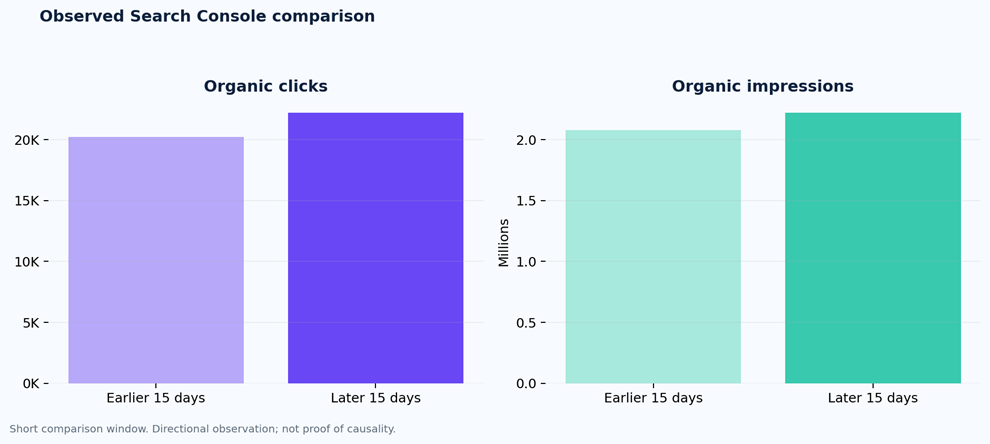
Figure: Observed clicks and impressions in two consecutive 15-day periods
Why this case study is anonymised
Healthcare websites handle sensitive topics and often operate under strict commercial and privacy constraints. The client name, patient information, queries and page-level details are withheld. The figures are aggregated from campaign reporting and rounded for readability.
Anonymisation limits independent verification, so the case should be read as a transparent account of process and observed movement—not a universal promise. Results depend on the starting point, market, implementation speed, competition and many factors outside an SEO’s control.
The starting challenge
The site had useful healthcare information and existing search visibility, but growth was uneven. Important topics were spread across pages with overlapping intent, internal linking did not consistently reinforce the highest-value journeys, and several content opportunities required stronger expert context. The authority profile also needed broader relevant referring-domain coverage.
Because medical queries can affect people’s wellbeing, the strategy could not chase traffic with sensational claims. Accuracy, clear authorship, appropriate review and careful language were essential. Commercial pages also needed to help users understand services without presenting general content as personal medical advice.
The measurement framework
Google Search Console was used to compare clicks, impressions, average position and query or page patterns. Backlink and keyword tools provided secondary indicators such as Domain Rating, referring domains and regional keyword visibility. Those third-party metrics are useful for diagnosis, but they are not Google ranking signals and can differ by vendor.
Before work was evaluated, key events and landing pages were reviewed so traffic movement could eventually be connected to enquiries or other meaningful actions. A short 15-day comparison is sensitive to seasonality and volatility, so the team treated it as an early signal and continued longer-term monitoring.
Workstream 1: technical and indexation priorities
The technical review focused on whether important pages could be discovered, rendered, indexed and consolidated correctly. Index directives, canonical signals, redirects, duplicate or thin URLs and internal paths were reviewed. Fixes were prioritised by likely impact and implementation effort rather than by the total number of audit findings.
Templates were checked for titles, headings, main content visibility and structured data alignment. Structured data was used to describe content accurately, not to make unsupported medical claims or guarantee enhanced search appearances.
Workstream 2: intent-led content improvements
The team mapped queries to patient and customer decisions: understanding a condition or service, comparing options, assessing risk, preparing for an appointment and selecting a provider. Existing pages were improved where they already matched intent; overlapping pages were consolidated or differentiated.
Introductions were rewritten to answer the core question quickly, followed by qualifications and detail. Headings became more specific. Important statements were reviewed against reliable sources, and pages were given clearer author or reviewer context where available. Commercial calls to action were placed without interrupting the informational answer.
Workstream 3: internal linking and conversion paths
Relevant informational pages were linked to the appropriate service or next-step page using descriptive anchors. Orphaned and weakly connected pages were addressed. The goal was not to place a fixed number of links in every article, but to make the relationship between topics and services understandable.
Calls to action were matched to intent. A reader early in research might need a related guide, while a user evaluating care might need contact or appointment information. This reduced the temptation to force every visitor directly into the same conversion step.
Workstream 4: authority development
The campaign pursued relevant referring domains and improved the usefulness of pages likely to earn citations. Reported referring domains increased from about 948 to 1,200, while the third-party Domain Rating moved from 4 to 7. These metrics suggest a broader link profile, but quality and relevance were reviewed separately.
The approach favoured legitimate topical mentions and useful resources. No conclusion was based on raw link count alone, because one credible healthcare or local reference can be more valuable than many unrelated placements.
Observed results
The 15-day comparison showed:
- Organic clicks: 20,200 to 22,200 (+9.9%)
- Organic impressions: 2.08 million to 2.22 million (+6.7%)
- Click-through rate: approximately 1%
- Reported average position: 6.9
- Referring domains: about 948 to 1,200
- Third-party Domain Rating: 4 to 7
- Third-party estimated organic traffic movement: +324
- Reported keyword movement by database: India +295, United States +61, Philippines +3
The figures do not all share the same methodology. Search Console reports Google search performance; third-party tools estimate traffic, links and keyword databases. They should not be added together or treated as equivalent.
What the numbers do and do not prove
The click and impression gains are consistent with improving visibility, but a short comparison cannot isolate causality. Algorithm changes, demand, news cycles, brand activity and measurement differences may contribute. CTR staying near 1% also showed that snippet relevance and query mix still deserved attention.
The responsible next step was to extend the comparison window, segment branded and non-branded performance, assess page-level conversion quality and continue expert review of healthcare content.
Lessons for other healthcare websites
First, protect accuracy and trust even when growth is the goal. Second, fix discovery and consolidation before scaling production. Third, make expert information easy to verify. Fourth, connect educational content with a respectful next step. Finally, report limitations alongside wins.
You can review the broader SEO services and delivery areas or discuss a confidential assessment for a site-specific plan.
Frequently asked questions
Is 15 days enough to judge SEO success?
No. It can reveal an early signal, but quarterly and longer comparisons are more dependable, especially when adjusted for seasonality and site changes.
Why is the CTR only around 1%?
Large informational impression volumes, ranking distribution and SERP features can suppress CTR. Query and page segmentation is needed before diagnosing it.
Are Domain Rating and referring domains Google metrics?
No. They are third-party measurements used for competitive analysis; Google Search Console metrics should be reported separately.
Are similar results guaranteed?
No. Every website, market and implementation differs. The case demonstrates a process and observed outcome, not a guarantee.
External references
CMS instruction: set every reference below to rel=”nofollow noopener” when publishing.
- Google Search Console: Performance report
- Google: Creating helpful, reliable, people-first content
- Google: Article structured data

About Huzaifa Mansoor
Huzaifa Mansoor is a Karachi-based SEO consultant and founder of HuzDigital, helping businesses improve technical SEO, content performance, Local SEO and AI-search visibility.