An AI visibility audit measures whether an answer engine mentions your brand, represents it accurately and cites pages that can influence a buyer. Build a fixed set of real customer questions, test them under controlled conditions, record mentions and sources, inspect the cited pages, then improve entity clarity, evidence and crawlable content. Repeat the same test monthly rather than relying on isolated screenshots.
AI visibility audit scoring model
| Score | Observed result | Recommended action |
| 0 | Brand absent | Check eligibility, evidence and authority gaps |
| 1 | Unlinked mention | Improve factual clarity and owned evidence |
| 2 | Accurate description | Strengthen source-worthy proof |
| 3 | Linked citation | Maintain accuracy and topic coverage |
| 4 | Relevant recommendation | Monitor consistency and lead quality |
Score a stable prompt sample; do not treat one response as a universal rank.
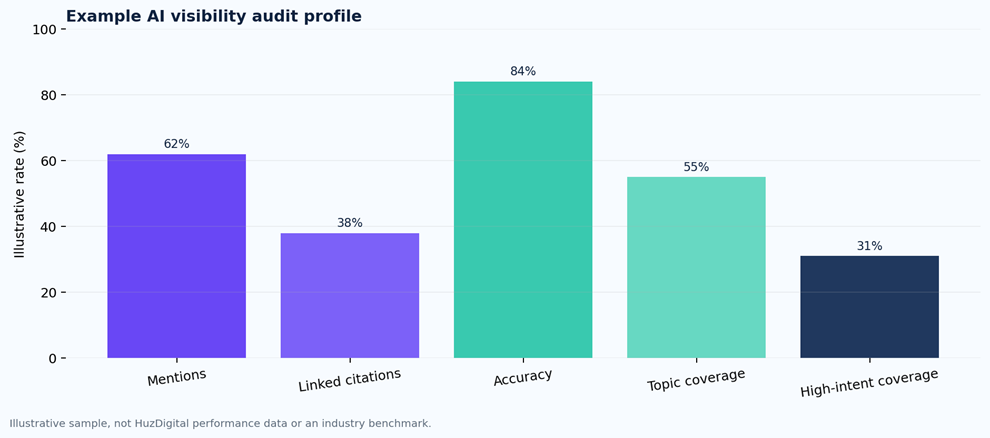
Figure: Illustrative AI visibility rates across five audit dimensions
Define what visibility means before testing
AI visibility is not a single rank. A business may be named but not linked, cited for an informational answer but absent from vendor recommendations, or described inaccurately. Track at least five outcomes: brand mention, linked citation, recommendation position, factual accuracy and sentiment or framing.
Separate branded prompts from non-branded prompts. “What does Company X offer?” tests entity understanding. “Who are reliable SEO consultants in Pakistan?” tests category discovery. “How much does SEO cost in Pakistan?” tests informational citation opportunity. Each reveals a different gap.
Build a prompt set from customer decisions
Start with 30–50 prompts drawn from sales calls, Search Console queries, support tickets and competitor comparisons. Group them by journey stage: problem discovery, solution education, provider comparison, risk reduction and local intent. Include natural variations because people ask complete questions in conversational tools.
For a local service business, prompts might include “best provider near me,” “how to choose,” “cost,” “alternatives,” “is it worth it,” and “who has experience in my industry.” Add your city and country where they change the answer. Keep the master list stable so one month can be compared with the next.
Test in a controlled way
Run prompts in ChatGPT, Gemini and Google Search where AI Overviews appear. Note the date, model or product, location, account state and whether the conversation was fresh. Results can vary by context and time, so one response is evidence of an observation—not a universal ranking.
Record the answer, brand mentions, cited URLs, competitors, wording and any incorrect claims. For Google, also inspect the standard results around the AI feature. Google states that pages appearing as supporting links must be indexed and eligible to show a snippet; it does not require a special AI file, special schema or separate optimisation method.
Score the results consistently
Create a simple score for each prompt: 0 for absent, 1 for mentioned, 2 for mentioned with an accurate description, 3 for linked or cited, and 4 for clearly recommended with relevant evidence. Report the percentage of prompts where the brand appears, citation share, accuracy rate and coverage by topic cluster.
Do not turn this into a vanity index. Weight prompts by commercial importance. Being cited for ten low-value definitions may matter less than appearing for two high-intent comparisons that influence qualified leads.
Audit the sources behind the answers
List every domain and page cited across the sample. Classify sources as your website, competitor sites, publishers, directories, review platforms, communities or primary research. Then ask why the source is useful: does it contain a concise answer, original data, expert quotes, transparent methodology, comparison table or strong entity information?
My guide to how LLM citations work explains why extractable claims and corroboration matter. The practical lesson is to make important facts easy to find, understand and verify.
Inspect your website foundations
Confirm that important pages can be crawled and indexed. Check canonical tags, robots directives, rendering, internal links and snippet eligibility. Put the core answer in visible text rather than only in an image or video. Use descriptive titles and headings, provide authorship, show update dates when meaningful and match structured data to visible content.
Clarify the business entity across the site: official name, service categories, location, founder or experts, contact details and relevant profiles. Maintain the Google Business Profile for local companies. Add evidence that another source can validate—case studies, methodology, credentials, customer examples and original research.
Turn gaps into an action plan
If the brand is absent from cost questions, publish a transparent pricing framework. If competitors dominate comparisons, create a balanced decision guide rather than a self-congratulatory sales page. If tools cite outdated facts, correct the canonical website page and align trusted profiles. If a strong page exists but is not indexed or internally linked, repair discovery before writing more.
Prioritise actions by buyer value, evidence gap and implementation effort. For strategic help across technical SEO, content and AI discovery, see SEO and AI visibility support.
Report with honest limitations
Use a monthly dashboard showing prompt coverage, mention rate, citation rate, accurate-answer rate, cited-domain share and leads influenced by organic or AI discovery where measurable. Keep screenshots or exports for auditability. Explain that outputs are probabilistic and interfaces change; movement should be interpreted as a trend across a stable sample.
Frequently asked questions
Can I rank number one in ChatGPT?
Not in the traditional sense. Responses vary by model, context and time. Measure recurring inclusion, citations and accuracy across valuable prompts instead.
Does llms.txt guarantee AI citations?
No. There is no general guarantee that publishing the file causes inclusion. Focus first on crawlable, useful, well-supported web content and clear entities.
Do I need special AI schema?
Google says no special schema is required for its AI features. Use appropriate structured data that accurately matches visible content.
How often should I repeat the audit?
Monthly is practical for most businesses; high-volume or fast-changing brands may sample weekly while maintaining the same prompt set and conditions.
External references
- Google: AI features and your website
- Google: Creating helpful, reliable, people-first content
- Google Search Console: Performance report
- Google: Article structured data

About Huzaifa Mansoor
Huzaifa Mansoor is a Karachi-based SEO consultant and founder of HuzDigital, helping businesses improve technical SEO, content performance, Local SEO and AI-search visibility.