
How local businesses in Karachi and Lahore can get found by AI search, without a big budget
What is GEO, and why should a small business in Pakistan care?
Generative Engine Optimization (GEO) is the practice of structuring your website content so AI tools, including Google AI Overviews, ChatGPT, Gemini, and Perplexity, can understand it, trust it, and use it to answer questions directly. For a small business, this matters because a growing share of local searches (“best seo expert in karachi,” “affordable digital marketer near me“) are now being answered by AI before the user ever clicks a link. If your content isn’t structured for AI to read and cite, you’re invisible in that answer, no matter how good your service is.
Unlike traditional SEO, where the goal was simply to rank on page one, GEO adds a second goal: getting quoted, summarized, or recommended inside an AI-generated answer.
Why GEO matters more for small and local businesses than you’d think
Large brands can win visibility through paid ads and sheer content volume. Small businesses usually can’t compete there. But GEO levels the field in a specific way:
- AI tools reward clarity, not budget. A well-structured FAQ page from a small local business can get cited over a vague page from a bigger competitor.
- Local intent queries are exactly what AI Overviews try to answer directly. Searches like “best,” “near me,” “affordable,” and “in Lahore” style queries are prime targets.
- Early-mover advantage exists. Very few small businesses in Pakistan have optimized for GEO yet. The businesses that do it now will have a head start before it becomes standard practice.
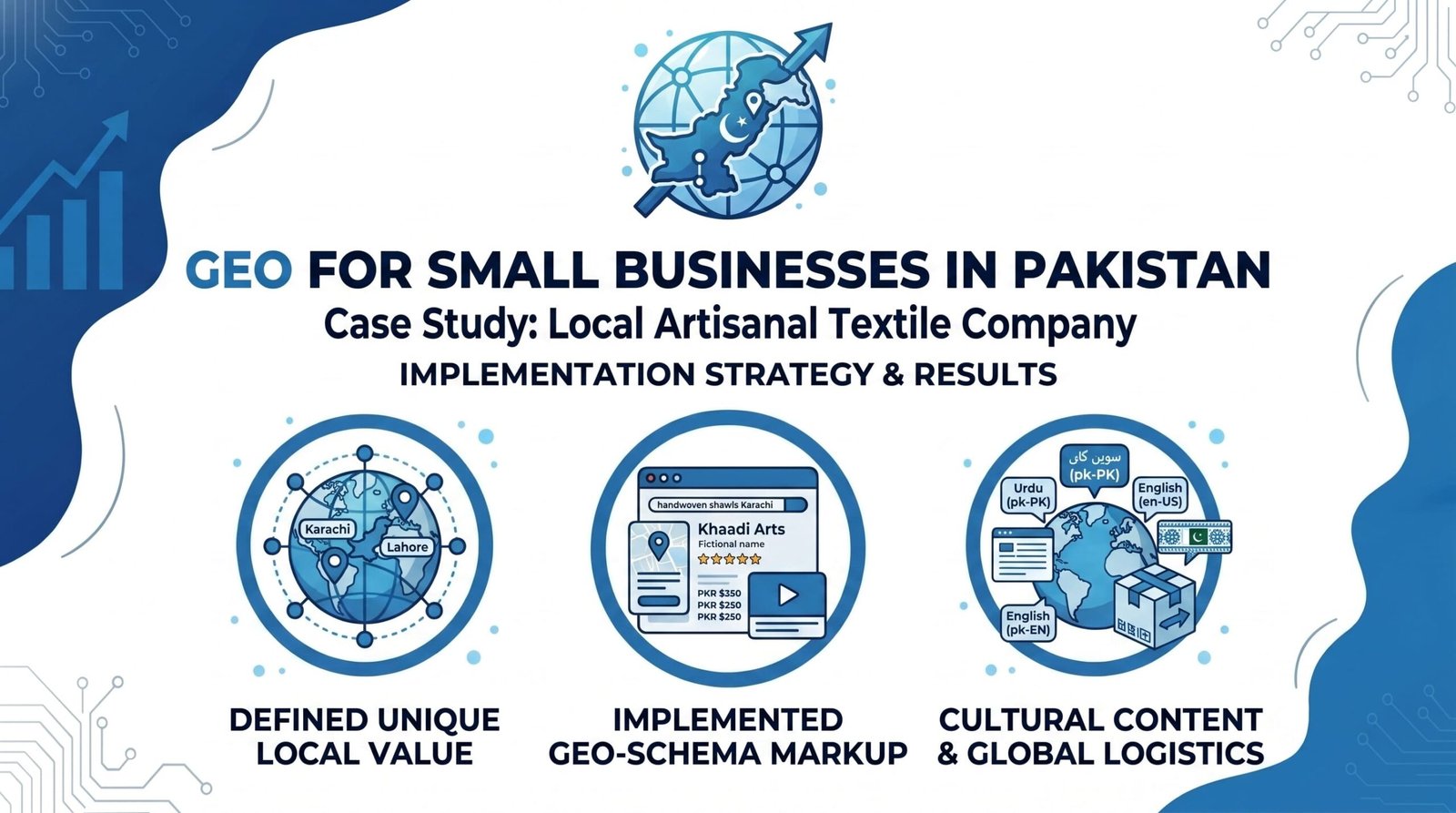
Case study: a Karachi-based service business
Consider a small digital marketing consultancy based in Karachi, offering SEO and content services to local clients (a common business type in this space, illustrative of a repeatable pattern).
Before:
- Homepage had generic language, such as “we provide result-oriented SEO solutions,” with no specifics
- No FAQ section anywhere on the site
- No schema markup implemented
- Google Business Profile incomplete (no photos, inconsistent phone number listed across directories)
- Search visibility: high impressions on broad queries, but poor click-through and no AI citations
What changed:
- Rewrote the homepage and service pages to lead with a direct, specific answer to the query the page targets (e.g., “How much does SEO cost in Pakistan?” answered in the first two lines, then expanded)
- Added an FAQ section to every core service page, with FAQ schema markup
- Standardized Name, Address, Phone (NAP) across Google Business Profile, directories, and the website footer
- Added real specifics, including pricing ranges, deliverables, and timelines, replacing generic marketing language
- Collected and displayed real client reviews on the site, not just on third-party platforms
After:
- Service pages began appearing in AI-generated answers for pricing and “how to choose an SEO expert” style queries
- Click-through rate on key pages improved as titles and meta descriptions became more specific
- Local visibility improved for “near me” and city-specific queries
This is the pattern most small businesses can replicate. It isn’t about volume of content, it’s about specificity and structure.
Step-by-step GEO tactics for small businesses (low budget)
1. Restructure pages to answer first
Every service or product page should open with a direct 2 to 3 line answer to the question a visitor (or an AI model) is likely asking. Save the elaboration for after.
2. Add FAQ schema without needing a developer
Most website builders (WordPress with Yoast/RankMath, Wix, Squarespace) have built-in or plugin-based FAQ schema tools. Add 3 to 5 real questions per page, answered in plain language.
3. Optimize Google Business Profile
This directly feeds local AI answers. Fill in every field: hours, services, photos, categories. Keep it updated, since stale profiles are deprioritized.
4. Get listed on local directories consistently
Consistent NAP (Name, Address, Phone) across directories, social profiles, and your website builds the trust signals AI systems rely on to verify a business is real and current.
5. Add simple trust signals
Real photos (not stock images), real reviews, a real address, and author information for blog content. AI systems favor content that demonstrates genuine experience and accountability.
Common mistakes small businesses make
- Generic “About Us” content with no specifics about services, pricing, or process
- No FAQ section at all, a missed, low-effort opportunity
- Inconsistent business information across Google, directories, and the website itself
- Ignoring reviews as a ranking and trust signal
- Treating GEO like traditional SEO by stuffing keywords instead of answering real questions clearly
Frequently asked questions
Is GEO expensive for small businesses?
No. Most of the highest-impact GEO tactics (answer-first content, FAQ schema, Google Business Profile optimization, consistent NAP) require time and attention to detail rather than budget. It’s more accessible to small businesses than large-scale paid advertising.
How is GEO different from local SEO?
Local SEO focuses on ranking in Google Maps and local search results. GEO focuses on being cited or summarized in AI-generated answers, which increasingly draw from the same signals (structured data, reviews, consistency) but weigh clarity and directness more heavily.
How long does it take to see GEO results?
Similar to SEO, expect early signals (impressions, minor ranking shifts) within a few weeks of changes, with more meaningful AI citation and traffic changes building over two to three months as content is re-crawled and trust signals accumulate.
Do I need a developer to implement schema markup?
Not usually. Most CMS platforms have plugins or built-in tools for FAQ and business schema. A developer is only needed for highly custom implementations.
Looking to get your business found in AI search results? Get a free GEO audit to see where your site stands today.

About Huzaifa Mansoor
Huzaifa Mansoor is a Karachi-based SEO consultant and founder of HuzDigital, helping businesses improve technical SEO, content performance, Local SEO and AI-search visibility.